Tuesday, October 9, 2012

A Brief Biography of Jean Piaget

A Brief Biography of Jean Piaget

Text and images provided courtesy of the Archives Jean Piaget
Piaget
 
Jean Piaget
 
Jean Piaget
 
Jean Piaget
 
Jean Piaget

Jean Piaget (1896-1980)

[just a dot]Jean Piaget was born in Neuchâtel (Switzerland) on August 9, 1896. He died in Geneva on September 16, 1980. He was the oldest child of Arthur Piaget, professor of medieval literature at the University, and of Rebecca Jackson. At age 11, while he was a pupil at Neuchâtel Latin high school, he wrote a short notice on an albino sparrow. This short paper is generally considered as the start of a brilliant scientific career made of over sixty books and several hundred articles. [just a dot]His interest for mollusks was developed during his late adolescence to the point that he became a well-known malacologist by finishing school. He published many papers in the field that remained of interest for him all along his life.
[just a dot]After high school graduation, he studied natural sciences at the University of Neuchâtel where he obtained a Ph.D. During this period, he published two philosophical essays which he considered as "adolescence work" but were important for the general orientation of his thinking.
[just a dot]After a semester spent at the University of Zürich where he developed an interest for psychoanalysis, he left Switzerland for France. He spent one year working at the Ecole de la rue de la Grange-aux-Belles a boys' institution created by Alfred Binet and then directed by De Simon who had developed with Binet a test for the measurement of intelligence. There, he standardized Burt's test of intelligence and did his first experimental studies of the growing mind.
[just a dot]In 1921, he became director of studies at the J.-J. Rousseau Institute in Geneva at the request of Sir Ed. Claparède and P. Bovet.
[just a dot]In 1923, he and Valentine Châtenay were married. The couple had three children, Jacqueline, Lucienne and Laurent whose intellectual development from infancy to language was studied by Piaget.
[just a dot]Successively or simultaneously, Piaget occupied several chairs: psychology, sociology and history of science at Neuchâtel from 1925 to 1929; history of scientific thinking at Geneva from 1929 to 1939; the International Bureau of Education from 1929 to 1967; psychology and sociology at Lausanne from 1938 to 1951; sociology at Geneva from 1939 to 1952, then genetic and experimental psychology from 1940 to 1971. He was, reportedly, the only Swiss to be invited at the Sorbonne from 1952 to 1963. In 1955, he created and directed until his death the International Center for Genetic Epistemology.
[just a dot]His researches in developmental psychology and genetic epistemology had one unique goal: how does knowledge grow? His answer is that the growth of knowledge is a progressive construction of logically embedded structures superseding one another by a process of inclusion of lower less powerful logical means into higher and more powerful ones up to adulthood. Therefore, children's logic and modes of thinking are initially entirely different from those of adults.
[just a dot]Piaget's oeuvre is known all over the world and is still an inspiration in fields like psychology, sociology, education, epistemology, economics and law as witnessed in the annual catalogues of the Jean Piaget Archives. He was awarded numerous prizes and honorary degrees all over the world.

Abraham Harold Maslow

http://upload.wikimedia.org/wikipedia/en/thumb/e/e0/Abraham_Maslow.jpg/220px-Abraham_Maslow.jpg
Abraham Harold Maslow (April 1, 1908 – June 8, 1970) was an American psychologist who was best known for creating Maslow's hierarchy of needs, a theory of self-actualization.[2] Maslow was a psychology professor at Brandeis University, Brooklyn College, New School for Social Research and Columbia University. He stressed the importance of focusing on the positive qualities in people, as opposed to treating them as a "bag of symptoms."[3]

Abraham Maslow Quotes

"For any man of good will, there is work to be done here, effective, virtuous, satisfying work which can give rich meaning to one's own life and to others"

Metamotivation

Maslow used the term metamotivation to describe self actualized people who are driven by innate forces beyond their basic needs, so that they may explore and reach their full human potential.[37]

B-values

In studying accounts of peak experiences, Maslow identified a manner of thought he called "Being-cognition" (or "B-cognition", which is holistic and accepting, as opposed to the evaluative "Deficiency-cognition" or "D-cognition") and values he called "Being-values".[38] He listed the B-values as:
  • Wholeness (unity; integration; tendency to one-ness; interconnectedness; simplicity; organization; structure; dichotomy-transcendence; order);
  • Perfection (necessity; just-right-ness; just-so-ness; inevitability; suitability; justice; completeness; "oughtness");
  • Completion (ending; finality; justice; "it's finished"; fulfillment; finis and telos; destiny; fate);
  • Justice (fairness; orderliness; lawfulness; "oughtness");
  • Aliveness (process; non-deadness; spontaneity; self-regulation; full-functioning);
  • Richness (differentiation, complexity; intricacy);
  • Simplicity (honesty; nakedness; essentiality; abstract, essential, skeletal structure);
  • Beauty (rightness; form; aliveness; simplicity; richness; wholeness; perfection; completion; uniqueness; honesty);
  • Goodness (rightness; desirability; oughtness; justice; benevolence; honesty);
  • Uniqueness (idiosyncrasy; individuality; non-comparability; novelty);
  • Effortlessness (ease; lack of strain, striving or difficulty; grace; perfect, beautiful functioning);
  • Playfulness (fun; joy; amusement; gaiety; humor; exuberance; effortlessness);
  • Truth (honesty; reality; nakedness; simplicity; richness; oughtness; beauty; pure, clean and unadulterated; completeness; essentiality).
  • Self-sufficiency (autonomy; independence; not-needing-other-than-itself-in-order-to-be-itself; self-determining; environment-transcendence; separateness; living by its own laws).

    Hierarchy of Needs

A visual aid was created to explain his theory, which was called the Hierarchy of Needs, is a pyramid depicting the levels of human needs, psychological and physical. When a human being ascends the steps of the pyramid he reaches self-actualization.
  • At the bottom of the pyramid are the “Basic needs or Physiological needs” of a human being: food, water, sleep and sex.
  • The next level is “Safety Needs: Security, Order, and Stability.” These two steps are important to the physical survival of the person. Once individuals have basic nutrition, shelter and safety, they attempt to accomplish more.
  • The third level of need is “Love and Belonging,” which are psychological needs; when individuals have taken care of themselves physically, they are ready to share themselves with others, such as with family and friends.
  • The fourth level is achieved when individuals feel comfortable with what they have accomplished. This is the “Esteem” level, the need to be competent and recognized, such as through status and level of success.
  • Then there is the “Cognitive” level, where individuals intellectually stimulate themselves and explore.
  • After that is the “Aesthetic” level, which is the need for harmony, order and beauty.[32]
  • At the top of the pyramid, “Need for Self-actualization,” occurs when individuals reach a state of harmony and understanding because they have achieved their full potential.[33] Once a person has reached the self-actualization state they focus on themselves and try to build their own image. They may look at this in terms of feelings such as self-confidence or by accomplishing a set goal.[34]
The first four levels are known as 'Deficit needs' or 'D-needs'. This means that if you don't have enough of one of those 4 needs, you'll have the feeling to get it. But when you do get them then you feel content. These needs alone are not motivating.[35]
Maslow wrote that there are certain conditions that must be fulfilled in order for the basic needs to be satisfied. For example, freedom of speech, freedom to express oneself, and freedom to seek new information[36] are a few of the prerequisites. Any blockages of these freedoms could prevent the satisfaction of the basic needs.
File:Maslow's Hierarchy of Needs.svg

Saturday, September 8, 2012

Linus Carl Pauling


Linus Carl Pauling (February 28, 1901 – August 19, 1994)[1] was an American chemistbiochemistpeace activist, author, and educator. He was one of the most influential chemists in history and ranks among the most important scientists of the 20th century.[2][3][4] Pauling was one of the founders of the fields of quantum chemistry and molecular biology.
Pauling is the only person to be awarded two unshared Nobel Prizes, one of only four individuals to have won more than one (Marie CurieJohn Bardeen and Frederick Sanger are the others) and one of only two people awarded Nobel Prizes in different fields (the Chemistry and Peace prizes), the other being Marie Curie (the Chemistry and Physics prizes). 

VITAMIN C AND CARDIOVASCULAR DISEASE


VITAMIN C AND CARDIOVASCULAR DISEASEA Personal Viewpoint by Alan Spencer and Andrew W. Saul

(OMNS, June 22, 2010) Linus Pauling was aware that studies of the animal kingdom showed that most animals have the ability to manufacture vitamin C in their bodies. Humans cannot. Furthermore, on average, mammals make 5,400mg daily when adjusted for body weight, and make more (often considerably more) when under stress or ill. This is about 100 times as much as the 50mg we get from a typical modern diet. It prompts the question, why do animals make so much vitamin C, and what purpose does it serve in the body.
A small number of animals which are known to share our inability to make vitamin C include the apes, the guinea pig, the fruit bat, and some birds, all of which will normally get a lot of vitamin C from their food. If you deprive a guinea pig of vitamin C it soon develops a form of cardiovascular disease (damage to its arteries showing within a few weeks). Similarly, studies of genetically modified mice have shown that if you switch off the gene that enables a mouse to produce vitamin C it will also soon show signs of heart disease. Re-introduction of a high vitamin C diet enables the damage to be reversed. While heart disease is rare in the animal kingdom, it is becoming a problem for apes in zoos where their diets are perhaps not as rich in vitamin C as when they are in the wild.
Collagen
A very important function of vitamin C in the body is its role in the production of collagen. Collagen is the most abundant protein in the body, and forms into fibres which are stronger than iron wire of comparable size. These fibres provide strength and stability to all body tissues, including the arteries. Vitamin C is absolutely essential for the production and repair of collagen, and is destroyed during the process, so a regular supply of vitamin C is necessary to maintain the strength of body tissues. Severe deficiency of vitamin C causes the total breakdown of body tissue witnessed in scurvy. Linus Pauling believed that whilst humans normally obtain sufficient vitamin C to prevent full-blown scurvy, we do not consume enough to maintain the strength of the walls of the arteries. He suggested that of all the structural tissues in the body, the walls of the arteries around the heart are subject to the greatest continual stress. Every time the heart beats the arteries are flattened and stretched, and this has been likened to standing on a garden hose thousands of times a day. Many tiny cracks and lesions develop and the artery walls become inflamed.
Dr. Pauling believed that in the presence of adequate supplies of vitamin C this damage can be readily repaired and heart disease is avoided. However, in the absence of adequate levels of vitamin C, the body attempts to repair the arteries using alternative materials: cholesterol and other fatty substances, which attach to the artery wall. (1-8)
Cholesterol and Lipoprotein (a), Lp(a)
The most abundant amino acids (protein building blocks) in collagen are lysine and proline, and when collagen strands are damaged lysine and proline become exposed. A special kind of cholesterol, lipoprotein(a), is attracted to lysine and proline and will attach itself to the exposed damaged collagen strands. It is an attempt by the body to repair damage to the collagen of the artery walls in the absence of adequate levels of vitamin C. Unfortunately the repair is not ideal and over many years repeated deposits can cause the artery to become narrow and inflamed. Heart attack or stroke is likely to follow (usually caused by a clot forming at the site of the narrowed artery, or by a piece of plaque breaking off and blocking a smaller vessel downstream). When vitamin C levels are low, the body manufactures more cholesterol, especially Lp(a). Conversely, when vitamin C levels are high the body makes less cholesterol.
If high blood cholesterol were the primary cause of heart disease, all bears and other hibernating animals would have become extinct long ago. They naturally have high cholesterol levels. One reason bears are still with us is simple: they produce large amounts of vitamin C in their bodies, which stabilises the artery walls, and there is therefore no tendency to develop cholesterol deposits or plaque.
Keeping healthy
The low levels of vitamin C that are available through diet are inadequate to prevent many people developing arterial plaques, and over time this may result in cardiovascular disease. Post mortem examinations showed that 77% of young American soldiers killed in the Korean war (average age 22) already had well-advanced atherosclerosis (heart disease), and post mortem studies from the Vietnam war gave similar results. Heart disease is not just a disease of the elderly, although it does not usually become life threatening until later in life.
How can we prevent it? Pauling believed that once we start taking high levels of vitamin C, the disease process is halted, or at least slowed, as Lp(a) cholesterol is no longer needed as a repair material. He also believed that when we take adequate levels of vitamin C, existing arterial plaques may start to be removed from the arteries. He found that the removal of plaques is more rapid if the amino acid lysine is taken along with vitamin C. Lysine appears to attach to the Lp(a) in existing plaque deposits and helps to loosen them. Linus Pauling recommended at least 3000mg of vitamin C per day as a preventive dose, and significantly higher levels of both vitamin C and lysine for the treatment of existing heart disease. Dosage is a key factor: low doses are ineffective.
Retention in the body
Another important point is that a single dose of vitamin C is not retained in the body for very long. This fact has been used for a long time by those who do not support the use of high doses of vitamin C as evidence that the body does not need and cannot use large doses. After a single large dose of vitamin C, the blood level quite soon returns to a low level. A lot is excreted, the high blood level only remaining for a few hours.
The key factor here is that the body is not designed to function with just a single large dose of vitamin C once a day. Animals are able to manufacture vitamin C in their bodies and do so continuously throughout the day. They have an enzyme which converts glucose to vitamin C, and each day they produce on the order of a hundred times more vitamin C than we are able to get from even a good diet. When animals are ill they manufacture even more, perhaps thousands of times more than we can get from our diet.
How much should we take?
For people who are essentially fit and well, the Vitamin C Foundation recommends perhaps 3,000mg of vitamin C per day, taken in divided doses as 500mg every four hours, as a protection against the development of heart disease. The problem with even this protective dose is that taking a tablet every four hours is not something that many people would want to adopt as part of their daily routine. But there is good evidence to suggest that this level of intake will help maintain the strength of the arteries and prevent the build up of cholesterol plaques. If everybody were to do this, perhaps heart disease would become a largely a thing of the past (as might many other chronic diseases).
When treating illness, "bowel tolerance" is the indicator of dosage level that should be used. This means taking just under the level of vitamin C (in divided doses) that results in loose stools. Everyone is different. Note that while a few 1,000mg doses a day might make you loose when you are fit and well, your "bowel tolerance" might increase to ten or even a hundred times this when very ill. So, for illness, the levels suggested by the Vitamin C Foundation are 6,000mg to 18,000mg of vitamin C per day (or up to bowel tolerance) plus 2,000mg to 6,000mg of lysine. These vitamin C levels may seem high, but are perhaps not particularly large when compared with levels seen in the animal kingdom. A substantial amount of lysine may be obtained from diet. For example, one may obtain 3,000 to 4,000 milligrams of lysine from about can and a half of beans. Supplementation reduces the need to consume that much.
Controversy
"Even though some physicians had observed forty or fifty years ago that amounts of vitamin C a hundred to a thousand times larger (than the RDA) have value in controlling various diseases, the medical profession and most scientists ignored this evidence." (Linus Pauling, How to Live Longer and Feel Better)
In medical circles, Pauling's recommendations remain controversial. However, his theory seems reasonable, and the implications are so significant that some major scientific trials should have been undertaken to assess it. This has not happened. Supporters of high-dose vitamin C have had their applications for research funding denied repeatedly, and have had to be content with carrying out small scale research projects and case studies. These have been very positive. Over the past fifteen years, Pauling therapy advocates have received hundreds of reports from heart patients who have self administered the therapy. It is reported that these people typically recover within 30 days, and the majority experience significant relief within as little as a week or two. In 1994, Linus Pauling wrote, "I think we can get almost complete control of cardiovascular disease, heart attacks and strokes by the proper use of vitamin C and lysine. It can prevent cardiovascular disease and even cure it. If you are at risk of heart disease, or if there is a history of heart disease in your family, if your father or other members of the family died of a heart attack or stroke or whatever, or if you have a mild heart attack yourself, then you had better be taking vitamin C and lysine."

References:
 (1) Rath M, Pauling L. Immunological evidence for the accumulation of lipoprotein(a) in the atherosclerotic lesion of the hypoascorbemic guinea pig. Proc Natl Acad Sci U S A. 1990 Dec;87(23):9388-90. PMID: 2147514. Free full text download: http://www.pnas.org/content/87/23/9388.full.pdf
(2) Rath M, Pauling L. Hypothesis: lipoprotein(a) is a surrogate for ascorbate. Proc Natl Acad Sci U S A. 1990 Aug;87(16):6204-7. [Erratum in: Proc Natl Acad Sci U S A 1991 Dec 5;88(24):11588.] PMID: 2143582. Free full text download: http://www.pnas.org/content/87/16/6204.full.pdf
(3) Rath M, Pauling L. Solution To the Puzzle of Human Cardiovascular Disease: Its Primary Cause Is Ascorbate Deficiency Leading to the Deposition of Lipoprotein(a) and Fibrinogen/Fibrin in the Vascular Wall. J Orthomolecular Med, Vol 6, 3&4th Quarters, 1991, p 125. Free full text download:http://orthomolecular.org/library/jom/1991/pdf/1991-v06n03&04-p125.pdf
(4) Pauling L, Rath M. An Orthomolecular Theory of Human Health and Disease. J Orthomolecular Med, Vol 6, 3&4th Quarters, 1991, p 135. Free full text download:http://orthomolecular.org/library/jom/1991/pdf/1991-v06n03&04-p135.pdf
(5) Rath M, Pauling L. Apoprotein(a) Is An Adhesive Protein. J Orthomolecular Med, Vol 6, 3&4th Quarters, 1991, p 139. Free full text download: http://orthomolecular.org/library/jom/1991/pdf/1991-v06n03&04-p139.pdf
(6) Rath M, Pauling L. Case Report: Lysine/Ascorbate Related Amelioration of Angina Pectoris. J Orthomolecular Med, Vol 6, 3&4th Quarters, 1991, p 144. Free full text download:http://orthomolecular.org/library/jom/1991/pdf/1991-v06n03&04-p144.pdf
(7) Rath M, Pauling L. A Unified theory of Human Cardiovascular Disease Leading the Way To the Abolition of This Diseases As A Cause for Human Mortality. J Orthomolecular Med, Vol 7, First Quarter 1992, p 5. Free full text download: http://orthomolecular.org/library/jom/1992/pdf/1992-v07n01-p005.pdf
(8) Rath M, Pauling L. Plasmin-induced Proteolysis and the Role of Apoprotein(a), Lysine and Synthetic Lysine Analogs. J Orthomolecular Med, Vol 7, First Quarter 1992, p 17. Free full text download:http://orthomolecular.org/library/jom/1992/pdf/1992-v07n01-p017.pdf
For More Information:
Fonorow O. Practicing Medicine Without a License? The Story of the Linus Pauling Therapy for Heart Disease. 2008. Lulu.com. ISBN-10: 1435712935; ISBN-13: 978-1435712935. Reviewed in J Orthomolecular Med, 2009. Vol 24, No 1, p 51-5.
Hickey S and Roberts H. Ascorbate: The Science of Vitamin C. 2004. ISBN-10: 1411607244; ISBN-13: 978-1411607248. Lulu.com. This book contains 575 references, and is reviewed athttp://www.doctoryourself.com/ascorbate.html
Hickey S, Saul AW. Vitamin C: The Real Story. Laguna Beach, CA: Basic Health Publications, 2008. ISBN: 978-1-59120-223-3. This book contains 387 references, and is reviewed athttp://www.doctoryourself.com/realstory.html
Levy TE. Stop America's #1 Killer: Reversible vitamin deficiency found to be the origin of all coronary heart disease. 2006. ISBN-10: 0977952002; ISBN-13: 978-0977952007. (Dr. Levy is a board-certified cardiologist.) Reviewed in J Orthomolecular Med, 2006. Vol 21, No 3, p 177-178. This book contains 60 pages of references. To download the review: http://orthomolecular.org/library/jom/2006/pdf/2006-v21n03-p175.pdf
Pauling L. How to Live Longer and Feel Better (Revised edition). Oregon State University Press, 2006. ISBN-10: 0870710966; ISBN-13: 978-0870710964. Reviewed in J Orthomolecular Med, 2006. Vol 21, No 3, p 175-177. To download the review: http://orthomolecular.org/library/jom/2006/pdf/2006-v21n03-p175.pdf
On the Web:
The Vitamin C Foundation http://www.vitamincfoundation.org
AscorbateWeb, a historical compendium of 20th-Century medical and scientific literature demonstrating the efficacy of vitamin C. http://www.seanet.com/~alexs/ascorbate/
Putting the "C" in Cure: Quantity and frequency are the keys to ascorbate therapy.http://orthomolecular.org/resources/omns/v05n11.shtml
RDA for Vitamin C is 10% of USDA Standard for Guinea Pigs.http://orthomolecular.org/resources/omns/v06n08.shtml

Nutritional Medicine is Orthomolecular Medicine
Orthomolecular medicine uses safe, effective nutritional therapy to fight illness. For more information:http://www.orthomolecular.org
The peer-reviewed Orthomolecular Medicine News Service is a non-profit and non-commercial informational resource.

Editorial Review Board:
Ralph K. Campbell, M.D. (USA)
Carolyn Dean, M.D., N.D. (Canada)
Damien Downing, M.D. (United Kingdom)
Michael Ellis, M.D. (Australia)
Michael Gonzalez, D.Sc., Ph.D. (Puerto Rico)
Steve Hickey, Ph.D. (United Kingdom)
James A. Jackson, Ph.D. (USA)
Bo H. Jonsson, M.D., Ph.D. (Sweden)
Thomas Levy, M.D., J.D. (USA)
Jorge R. Miranda-Massari, Pharm.D. (Puerto Rico)
Erik Paterson, M.D. (Canada)
Gert E. Shuitemaker, Ph.D. (Netherlands)
Andrew W. Saul, Ph.D. (USA), Editor and contact person. Email: omns@orthomolecular.org

Lemon, raw, without peel : nutrition Facts

Lemon, raw, without peel
Nutritional value per 100 g (3.5 oz)
Energy121 kJ (29 kcal)
Carbohydrates9.32 g
Sugars2.50 g
Dietary fiber2.8 g
Fat0.30 g
Protein1.10 g
Thiamine (vit. B1)0.040 mg (3%)
Riboflavin (vit. B2)0.020 mg (2%)
Niacin (vit. B3)0.100 mg (1%)
Pantothenic acid (B5)0.190 mg (4%)
Vitamin B60.080 mg (6%)
Folate (vit. B9)11 μg (3%)
Vitamin C53.0 mg (64%)
Calcium26 mg (3%)
Iron0.60 mg (5%)
Magnesium8 mg (2%)
Phosphorus16 mg (2%)
Potassium138 mg (3%)
Zinc0.06 mg (1%)
Percentages are relative to
US recommendations for adults.
Source: USDA Nutrient Database

A bee on a Meyer lemon flower

Tuesday, May 8, 2012

Janda Syndromes

Janda Syndromes

Janda’s Crossed Syndromes
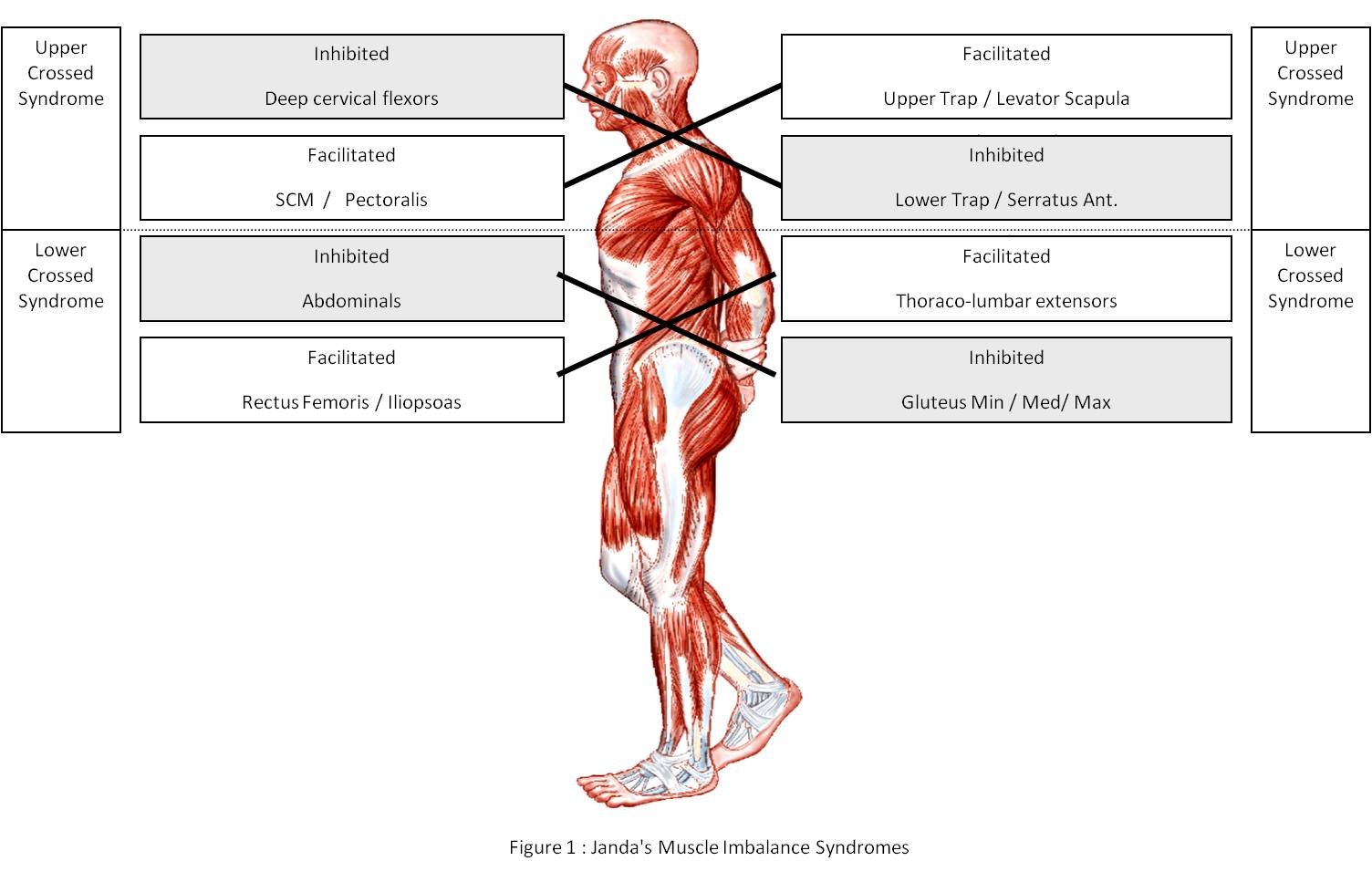
Over time, these imbalances will spread throughout the muscular system in a predictable manner. Janda has classified these patterns as “Upper Crossed Syndrome” (UCS), “Lower Crossed Syndrome” (LCS), and “Layer Syndrome” (LS) (Janda, 1987, 1988). [UCS is also known as “cervical crossed syndrome”; LCS is also known as “pelvic crossed syndrome; and LS is also known as “stratification syndrome.”] Crossed syndromes are characterized by alternating sides of inhibition and facilitation in the upper quarter and lower quarter. Layer syndrome, essentially a combination of UCS and LCS is characterized by alternating patterns of tightness and weakness, indicating long-standing muscle imbalance pathology. Janda’s syndromes are summarized in Figure 1.
Janda's Crossed Syndromes
Upper crossed syndrome is characterized by facilitation of the upper trapezius, levator, sternocleidomastoid, and pectoralis muscles, as well as inhibition of the deep cervical flexors, lower trapezius, and serratus anterior. Lower crossed syndrome is characterized by facilitation of the thoraco-lumbar extensors, rectus femoris, and iliopsoas, as well as inhibition of the abdominals (particularly transversus abdominus) and the gluteal muscles.
By using Janda’s classification, clinicians can begin to predict patterns of tightness and weakness in the sensorimotor system’s attempt to reach homeostasis. Janda noted that these changes in muscular tone create a muscle imbalance, which leads to movement dysfunction. Muscles prone to tightness generally have a “lowered irritability threshold” and are readily activated with any movement, thus creating abnormal movement patterns. These imbalances and movement dysfunctions may have direct effect on joint surfaces, thus potentially leading to joint degeneration. In some cases, joint degeneration may be a direct source of pain, but the actual cause of pain is often secondary to muscle imbalance. Therefore, clinicians should find and treat the cause of the pain rather than focus on the source of the pain.


Janda Evaluation

Systematic evaluation of muscular imbalance begins with static postural assessment, observing muscles for characteristic signs of hypertonicity or hypotonicity. This is followed by observation of single leg stance and gait. Static posture, gait and balance often give the best indication of the status of the sensorimotor system. Computerized force plate posturography is often valuable in quantifying sensory and motor deficits. Next, characteristic movement patterns are assessed, and specific muscles are tested for tightness or shortness. Surface electromyography is useful in quantifying muscle activation patterns. All the above information collected provides the clinician a system to determine or rule out the presence of muscle imbalance syndromes. Furthermore, identification of specific patterns and syndromes of imbalance also provides the clinician to choose appropriate interventions to address the cause of the dysfunction.

Janda Treatment

Janda’s Approach to Treatment
1. Normalize the periphery. The Janda approach to treatment of musculoskeletal pain follows several steps. Treatment of muscle imbalance and movement impairment begins with normalizing afferent information entering the sensorimotor system. This includes providing an optimal environment for healing (by reducing effusion and protection of healing tissues, restoring proper postural alignment (through postural and ergonomic education), and correcting the biomechanics of a peripheral joint (through manual therapy techniques).
2. Restore Muscle Balance. Once peripheral structures are normalized, muscle balance is restored. Normal muscle tone surrounding joints must be restored. Sherrington’s law of reciprocal inhibition (Sherrington, 1907) states that a hypertonic antagonist muscle may be reflexively inhibiting their agonist. Therefore, in the presence of tight and/or short antagonistic muscles, restoring normal muscle tone and/or length must first be addressed before attempting to strengthen a weakened or inhibited muscle. Techniques to decrease tone must be specific to the cause of the hypertonicity. These include post-isometric relaxation (PIR) (Lewit, 1994) and post-facilitation stretch (PFS) (Janda, 1988).
Muscles that have been reflexively inhibited by tight antagonists often recover spontaneously after addressing the tightness. In the Janda approach, the coordinated firing patterns of muscle are more important than the absolute strength of muscles. The strongest muscle is not functional if it cannot contract quickly and in coordination with other muscles; therefore, isolated muscle strengthening is not emphasized in the Janda approach. Instead, muscles are facilitated to contract at the proper time during coordinated movement patterns to provide reflexive joint stabilization.
3. Increase afferent input to facilitate reflexive stabilization. Once muscle balance has been addressed, Janda stresses increasing proprioceptive input into the CNS with a specific exercise program, “Sensorimotor Training” (SMT) (Janda & Vavrova, 1996). This program increases afferent information entering the subcortical pathways (including spinocerebellar, spinothalamic, and vestibulocerebellar pathways) to facilitate automatic coordinated movements. SMT involves progressive stimulation through specific exercises with increasing level of challenge to the sensorimotor system. SMT has been proven to improve proprioception, strength, and postural stability in ankle instability (Freeman et al. 1965), knee instability (Ihara & Nakayam, 1996), and after ACL reconstruction (Pavlu & Novosadova, 2001).
4. Increase endurance in coordinated movement patterns. Finally, endurance is increased through repetitive, coordinated movement patterns. Since fatigue is a predisposing factor to compensated movement patterns, endurance is also more important than absolute strength. Exercises are performed at low intensities and high volumes to simulate activities of daily living.
The Janda approach is valuable in today’s managed care environment. Once these patterns and syndromes are identified, specific treatment can be implemented without expensive equipment. Early detection of these causes of chronic pain allows the clinician to treat the patient with fewer visits and less expensive equipment compared to traditional interventions that emphasize modalities and passive treatments. The key to the Janda approach is in the home exercise program. Inexpensive home exercise equipment such as wobble boards, elastic bands, and foam pads are used with a specific progression of exercises as the patient improves in function.
Summary
In summary, the Janda approach emphasizes the importance of the CNS in the sensorimotor system, and its role in the pathogenesis in musculoskeletal pain. In particular: the neurological pre-disposition of muscles to exhibit predictable changes in tone, and the importance of proprioception and afferent information in the regulation of muscle tone and movement. Therefore, assessment and treatment focus on the sensorimotor system, rather than the musculoskeletal system itself. Using a functional, rather than a structural approach, the cause of musculoskeletal pain can be quickly identified and addressed. The Janda approach can be a valuable tool for the clinician in the evaluation and treatment of chronic musculoskeletal pain.