Important Days | ||||||||||||||||||||||||||||||||||||||||||||||||||||||||||||||||||||||||||||||||||||||||||||||||||||||||||||||||||||||||||||||||||||||||||||||||||||||||||||||||||||||||||||||
|
Sunday, August 15, 2010
Important Dates


Sunday, June 20, 2010
World Physical Therapy Day
WCPT has designated 8th September, the date WCPT was founded in 1951, as World Physical Therapy Day.
The day marks the unity and solidarity of the physical therapy community from 101 countries around the world. It is an opportunity to recognise the work that physical therapists do for their patients and community. WCPT aims to support member organisations in their efforts to promote the profession and to advance their clinical expertise, using World Physical Therapy Day as a focus.
Celebration of the day is entirely voluntary. Many WCPT member organisations already have designated national physical therapy days, weeks and months and it is not the intention that these be changed to accommodate the world day. However, organisations that have not designated a day may choose to use 8th September.
Celebration of the day is entirely voluntary. Many WCPT member organisations already have designated national physical therapy days, weeks and months and it is not the intention that these be changed to accommodate the world day. However, organisations that have not designated a day may choose to use 8th September.
World Physical Therapy Day 2009 activities - India
A number of institutions across India celebrated World Physical Therapy Day on 8 September 2009. Details of just some of these events are provided below:
To celebrate World Physical Therapy Day, the Dr MV Shetty College of Physiotherapy organised a workshop in collaboration with the Sports and Fitness Training Federation of India on 8th September 2009. The topic for the workshop was "Teaching Methodology" and a poster was made to promote the occasion.
Amity Institute of Physiotherapy, Amity University
Like every year, this year the Amity Institute of Physiotherapy celebrated World Physical Therapy Day at the Amity Campus. A seminar was organised at which distinguished physical therapists presented their views on the vital areas of the profession. The event generated much press coverage highlighting physical therapists’ scope of practice and the role they play in areas such as cardio vascular disease and obesity. Download a report and photos of the events. Read press cuttings [1.76mb].Physiotherapy Private Practitioners’ Group
The Physiotherapy Private Practitioners’ Group (PPG) in India celebrated World Physical Therapy Day with the following events:- an article titled ‘Today is World Physical Therapy Day’ was published in an Indian newspaper
- posters were displayed at parks, corporate offices, temples and public buildings, giving details of when to visit a physiotherapist
- seminars on ‘Physiotherapy management & pain prevention” and “Exercises to help delay in aging’ were delivered
- free physiotherapy camps were held
 Dr M V Shetty College of Physiotherapy
To celebrate World Physical Therapy Day, the Dr MV Shetty College of Physiotherapy organised a workshop in collaboration with the Sports and Fitness Training Federation of India on 8th September 2009. The topic for the workshop was "Teaching Methodology" and a poster was made to promote the occasion.McKenzie Institute
McKenzie India celebrated World Physiotherapy Day by organising a McKenzie overview programme in Pune on 5th September, at DY Patil Physiotherapy College, Pimpri. The overview lasted 3 hours and was supported by a PowerPoint presentation from the McKenzie Institute International, New Zealand. The event was well attended and successful.Sunday, May 2, 2010
NTNU - Norwegian Institute of Science and Technology
How to apply
– International students
NTNU welcomes international students, either as degree students or as visiting or exchange students. Close to 10 per cent of NTNU students come from countries other than Norway, and the university offers a variety of programmes and services to help international students feel welcome and to find the information they need during their studies here.
While many undergraduate courses are taught in Norwegian, many master's and PhD programmes are available in English. The university also offers Norwegian language instruction.
Admission and language requirements, like application procedures, vary depending on the type of programme you intend to pursue (degree, international master's programme, PhD, exchange, visiting/non-degree).
Although all Norwegian universities are tuition-free, Norway requires all international students to document or declare a minimum of NOK 85 000 per year in funds to cover living and other expenses.
The general admission and language requirements for the university's various study options are provided under each category in the left menu.
You can find the general English language requirements for ordinary degree-seeking students at NTNU here. See also: Norwegian language requirements for degree-seeking students.
If you are an Exchange student or visiting student and do not require additional information, use the online application to apply.
International Master's Programmes
– Degree students
NTNU offers dozens of different International Master`s Programmes taught in English, ranging from subject areas in the arts, social sciences, natural sciences, engineering, architecture, medicine and Erasmus Mundus. If you want to apply, you should know that the university receives thousands of requests for information about admission from international applicants every year, which makes the competition for places in each programme quite strong.
CATEGORIES OF APPLICANTS
The academic and English-language requirements vary depending upon your educational background and source of funding, as described here:
| |
| |

International Master's Programmes
NTNU offers more than 30 international master's programmes taught in English, ranging from the humanities, social sciences, natural sciences, engineering, architecture, medicine and Erasmus Mundus programmes.
Programme Catalogue 2010-2011 (PDF)
Because the language of instruction for these programmes is English, you don't have to comply with NTNU's Norwegian language requirements. You do, however, have to be able to demonstrate your English-language proficiency if you come from a country where a language other than English is the native language.
MPhil in Childhood Studies
MSc in Chemical Engineering
MSc in Coastal and Marine Civil Engineering
MSc in Condensed Matter Physics
MPhil in Development Studies - Specializing in Geography
MPhil in Development Studies - Specializing in Urban Challenges in East Africa
MSc in Electric Power Engineering
MPhil in English Linguistics and Language Acquisition
MSc in Environmental Toxicology and Chemistry
MSc in Exercise Physiology/Sports Sciences
MSc in Geotechnics and Geohazards
MSc in Globalization - Global Technology Management
MSc in Globalization - Global Politics and Culture
MPhil in Human Development
MSc in Hydropower Development
MSc in Industrial Ecology
MSc in Information Systems
MSc in Innovative Sustainable Energy Engineering- (New from 2009)
MSc in Light Metals Production
MPhil in Linguistics
MSc in Marine Coastal Development
MSc in Marine Technology
MSc in Mathematics
MSc in Medical Technology
MSc in Molecular Medicine
MSc in Natural Gas Technology - (New from 2009)
MSc in Natural Resources Management
MSc in Neuroscience
MSc in Petroleum Engineering/MSc in Petroleum Geosciences
MSc in Project Management
MSc in Reliability, Availability, Maintainability and Safety (RAMS)
MPhil in Risk Psychology, Environment and Safety
MSc in Silicon and Ferroalloy Production
Msc In Sustainable Architecture (new from 2010)
MSc in Telematics - Communication Networks and Networked Services
MSc in Urban Ecological Planning (Next admission 2011)
Erasmus Mundus:
Master's Programme in Applied Ethics
Master's Programme in Coastal and Marine Engineering and Management
Master's Programme in Security and Mobile Computing
Master's Programme in Embedded Computing Systems
NOMA:
Norad’s Programme for Master Studies:
- MSc Programme in Petroleum Engineering and Petroleum Geoscience
- MSc Sandwich Programme within the Petroleum Sector in Asia and Africa
- Master's Programme in Sustainable Energy Systems
- MSc Programme in Hydropower Development
- MSc Programme in Mathematics
Wednesday, December 31, 2008
BELL's Palsy முக வாதம்
Definition
Bell's palsy is a sudden weakness and paralysis on one side of the face, men and women equally.

Risk Factors
A risk factor is something that increases your chance of getting a disease or condition. Risk factors for Bell's palsy include:
Family members who have Bell's palsy
Pregnancy
Diabetes
Cold or flu (most common / winter season)
Weakened immune system
Symptoms
Bell's palsy symptoms may come on suddenly or develop over a few days. Initial symptoms may include:
Pain behind the ear that precedes the weakness and paralysis
Ringing sound in the ears
Slight fever
Slight hearing impairment
Symptoms of full-blown Bell's palsy may include:
Facial weakness or paralysis:
Usually on one side
Forehead is smooth
Not able to smile
Numbness just before the weakness starts
Drooping corner of the mouth
Drooling
Tearing
Inability to close an eye, which can lead to:
The eye becoming dehydrated
Ulcers forming on the cornea
Infection
Possible loss of the eye
Dry eye
Impaired taste
Sound sensitivity in one ear
Earache
Difficulty speaking
Grading of Bells Palsy
House-Brackmann Scale
Our main measuring instrument is the House-Brackmann grading scale which
goes from I (normal) to VI (no movement).
Grade & Definition
I Normal symmetrical function in all areas
II Slight weakness noticeable only on close inspection Complete eye closure with minimal effort Slight asymmetry of smile with maximal effort Synkinesis barely noticeable, contracture, or spasm absent
III Obvious weakness, but not disfiguring May not be able to lift eyebrow Complete eye closure and strong but asymmetrical mouth movement with maximal effort Obvious, but not disfiguring synkinesis, mass movement or spasm
IV Obvious disfiguring weakness Inability to lift brow Incomplete eye closure and asymmetry of mouth with maximal effort Severe synkinesis, mass movement, spasm
V Motion barely perceptible Incomplete eye closure, slight movement corner mouth Synkinesis, contracture, and spasm usually absent
VI No movement, loss of tone, no synkinesis, contracture, or spasm
House, J.W. and Brackmann, D.E. (1985) Facial nerve grading system.
Otolaryngol. Head Neck Surg., 93, 146–147.
TREATMENT: முக - பயிற்சிகள்


Definition
Bell's palsy is a sudden weakness and paralysis on one side of the face, men and women equally.

Risk Factors
A risk factor is something that increases your chance of getting a disease or condition. Risk factors for Bell's palsy include:
Family members who have Bell's palsy
Pregnancy
Diabetes
Cold or flu (most common / winter season)
Weakened immune system
Symptoms
Bell's palsy symptoms may come on suddenly or develop over a few days. Initial symptoms may include:
Pain behind the ear that precedes the weakness and paralysis
Ringing sound in the ears
Slight fever
Slight hearing impairment
Symptoms of full-blown Bell's palsy may include:
Facial weakness or paralysis:
Usually on one side
Forehead is smooth
Not able to smile
Numbness just before the weakness starts
Drooping corner of the mouth
Drooling
Tearing
Inability to close an eye, which can lead to:
The eye becoming dehydrated
Ulcers forming on the cornea
Infection
Possible loss of the eye
Dry eye
Impaired taste
Sound sensitivity in one ear
Earache
Difficulty speaking
Grading of Bells Palsy
House-Brackmann Scale
Our main measuring instrument is the House-Brackmann grading scale which
goes from I (normal) to VI (no movement).
Grade & Definition
I Normal symmetrical function in all areas
II Slight weakness noticeable only on close inspection Complete eye closure with minimal effort Slight asymmetry of smile with maximal effort Synkinesis barely noticeable, contracture, or spasm absent
III Obvious weakness, but not disfiguring May not be able to lift eyebrow Complete eye closure and strong but asymmetrical mouth movement with maximal effort Obvious, but not disfiguring synkinesis, mass movement or spasm
IV Obvious disfiguring weakness Inability to lift brow Incomplete eye closure and asymmetry of mouth with maximal effort Severe synkinesis, mass movement, spasm
V Motion barely perceptible Incomplete eye closure, slight movement corner mouth Synkinesis, contracture, and spasm usually absent
VI No movement, loss of tone, no synkinesis, contracture, or spasm
House, J.W. and Brackmann, D.E. (1985) Facial nerve grading system.
Otolaryngol. Head Neck Surg., 93, 146–147.
TREATMENT: முக - பயிற்சிகள்


Saturday, November 15, 2008
A Ten Minute Guide to a Better Back
There are hundreds of different exercises that can be used to strengthen and improve the flexibility of the lower back. These exercises have been selected because they are effective, easy to do and focus on important muscular structures. This exercise routine will take about ten minutes to complete. A brief walk is a good warm up. Daily use of this program, even when your back feels good, will help to keep your back healthy and strong.
Regular physical activity is recommended to compliment this back care program. As you do these exercises you will feel some stretching, but it should not be painful. If you are experiencing pain, check with your physician or therapist before continuing to do the exercises.
Low Back Rotation
Slowly lower both knees to the side keeping your lower back flat on the
ground. Hold for 2-3 seconds then gently move the knees to the other
side. Repeat 3-4 times.

Pelvic Tilt (front to back)
Flatten the small of your back against the floor. Your pelvis should be
tilted backward. Hold the position for 2 -3 seconds and then slowly move
the pelvis back in the opposite direction so the lower back is arched. Hold
this position for 2 - 3 seconds. Repeat the full movement three or four
times. This exercise should be done slowly.

Pelvic Tilt (side to side)
Lie on your back and move your right hip up in the direction of your right
shoulder. Hold for 2-3 seconds. Repeat on the other side. The back
should be flat against the ground during the entire exercise. Repeat the
full movement slowly 3 - 4 times.

Hamstring Stretch
Place one leg up so that your heel rests against a door frame. Straighten both
knees and adjust your hip so that you feel the hamstring comfortably stretch.
s toward the frame to increase the stretch. After 20 - 30 seconds, scoot your hip
Repeat several times and then stretch the other side.

Hip Stretch (Piriformis Muscle Stretch)
Grasp your knee and ankle. Now pull across your chest toward the opposite
shoulder. You should feel the stretch in your buttock region. Hold the position for
2 - 3 seconds and then repeat using the opposite leg. Do this several times on
each side.

Abdominal Strengthening (crunches)
Support your neck and tighten your stomach muscles. Slowly raise your head and
upper back off the floor so that your shoulder blades are off the floor. Hold the
position for 2 - 3 seconds and then slowly lower your head and shoulders back
down to the floor. Start with 10 - 15 repetitions and gradually increase the number
as you get stronger.

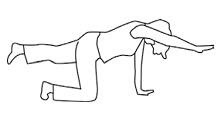
Back Extension
Start on your hands and knees and then raise your right leg and left arm,
keeping your back straight. Hold for l0 seconds and return to the starting
position, then raise the opposite arm and leg, again keeping your back straight,
and hold for 1-2 seconds. Repeat 5-10 times on each side.
Sitting Knee Lifts
Sit in a comfortable chair keeping your back straight. Tighten your stomach
muscles to help stabilize the spine. Slowly raise one leg up until the foot is
8 - 10 inches off the ground. Hold for 2 - 3 seconds and then slowly lower the leg.
Repeat using the opposite leg. Start with 5 - 10 repetitions and gradually increase
the number as you get stronger.

Wall Squats
Tighten your stomach muscles and flatten your back against the wall. Slide your
back down the wall until you are halfway to a sitting position. Hold the position for
20 - 30 seconds and then slide back up to the starting position keeping your back
flat against the wall. As you get stronger, slide further down to a sitting position.
 koushik
Regular physical activity is recommended to compliment this back care program. As you do these exercises you will feel some stretching, but it should not be painful. If you are experiencing pain, check with your physician or therapist before continuing to do the exercises.
Low Back Rotation
Slowly lower both knees to the side keeping your lower back flat on the
ground. Hold for 2-3 seconds then gently move the knees to the other
side. Repeat 3-4 times.

Pelvic Tilt (front to back)
Flatten the small of your back against the floor. Your pelvis should be
tilted backward. Hold the position for 2 -3 seconds and then slowly move
the pelvis back in the opposite direction so the lower back is arched. Hold
this position for 2 - 3 seconds. Repeat the full movement three or four
times. This exercise should be done slowly.

Pelvic Tilt (side to side)
Lie on your back and move your right hip up in the direction of your right
shoulder. Hold for 2-3 seconds. Repeat on the other side. The back
should be flat against the ground during the entire exercise. Repeat the
full movement slowly 3 - 4 times.

Hamstring Stretch
Place one leg up so that your heel rests against a door frame. Straighten both
knees and adjust your hip so that you feel the hamstring comfortably stretch.
s toward the frame to increase the stretch. After 20 - 30 seconds, scoot your hip
Repeat several times and then stretch the other side.

Hip Stretch (Piriformis Muscle Stretch)
Grasp your knee and ankle. Now pull across your chest toward the opposite
shoulder. You should feel the stretch in your buttock region. Hold the position for
2 - 3 seconds and then repeat using the opposite leg. Do this several times on
each side.

Abdominal Strengthening (crunches)
Support your neck and tighten your stomach muscles. Slowly raise your head and
upper back off the floor so that your shoulder blades are off the floor. Hold the
position for 2 - 3 seconds and then slowly lower your head and shoulders back
down to the floor. Start with 10 - 15 repetitions and gradually increase the number
as you get stronger.

Back Extension
Start on your hands and knees and then raise your right leg and left arm,
keeping your back straight. Hold for l0 seconds and return to the starting
position, then raise the opposite arm and leg, again keeping your back straight,
and hold for 1-2 seconds. Repeat 5-10 times on each side.

Sitting Knee Lifts
Sit in a comfortable chair keeping your back straight. Tighten your stomach
muscles to help stabilize the spine. Slowly raise one leg up until the foot is
8 - 10 inches off the ground. Hold for 2 - 3 seconds and then slowly lower the leg.
Repeat using the opposite leg. Start with 5 - 10 repetitions and gradually increase
the number as you get stronger.

Wall Squats
Tighten your stomach muscles and flatten your back against the wall. Slide your
back down the wall until you are halfway to a sitting position. Hold the position for
20 - 30 seconds and then slide back up to the starting position keeping your back
flat against the wall. As you get stronger, slide further down to a sitting position.
 koushik
Fitness Terminlogies
FITNESS TERMINOLOGY
Before you start an exercise program, consult your therapist and physician.
We would like to introduce you to some common fitness terms that will hopefully
improve your knowledge of and interest in physical fitness.
Fitness - sound physically and mentally; AKA healthy
Repetitions (commonly called "reps") - the number of times one repeats a movement.
For example, if you lift a weight with your arm 10 times, you have performed 10
repetitions.
Set(s) - a discrete number of repetitions. For example, if you lift a weight 10 times, rest,
and lift the weight 10 times again, you have performed "two sets" of 10 repetitions.
Muscle - the contractile unit responsible for moving your bones.
Tendon - the non-contractile unit that transmits the force of the muscle to the bone.
Tendons connect muscles to bones.
Ligament - the soft tissues that hold two or more bones together.
Cartilage - connective tissue that covers the ends of bones and acts as a cushion to
absorb shock and a smooth surface to decrease friction between two or more bones in a
moving joint.
Aerobic Exercise - The American College of Sports Medicine (ACSM) defines
aerobic exercise as "any activity that uses large muscle groups, can be maintained
continuously, and is rhythmic in nature." Aerobic means in the presence of oxygen. In
other words, your body is burning its fuel (glucose) in the presence of oxygen. It is
performed at less than 85% of your maximum heart rate. An aerobically fit individual can
work longer, more vigorously and achieve a quicker recovery at the end of the aerobic
session. Jogging, cycling, swimming, aerobics classes, and rowing are examples of
aerobic exercise.
Anaerobic Exercise - working at higher than 85% of your maximum heart rate. It
involves short bursts of exertion followed by periods of rest. Anaerobic mean in the
absence of oxygen. In other words, it is the burning of glucose, by the body, without the
use of oxygen. Weight training and sprinting are examples of anaerobic exercise.
Plyometrics - Exercises characterized by the application of a quick muscle stretch
followed by rapid muscle shortening enabling muscle(s) to achieve maximal rates of
force development. They are intended to improve reactive/explosive muscle performance.
Circuit Training - selected weight-training exercises performed one after another in
an exercise sequence, usually using lighter weights and short periods of rest.
Flexibility - the total range of motion in a joint or joints.
Strength - a muscle(s) ability to generate force. It is usually measured with a one
repetition maximum.
Resistance Training - the use of external force to build up the body's ability to exert
muscular force. AKA - weight or strength training.
Endurance - the ability of muscle(s) to contract repeatedly and resist fatigue.
- a muscle(s) ability to generate force. It is usually measured with a one
repetition maximum.
Resistance Training - the use of external force to build up the body's ability to exert
muscular force. AKA - weight or strength training.
Endurance - the ability of muscle(s) to contract repeatedly and resist fatigue.
Core Strength - a multi-joint exercise, involving larger muscle groups such as the
chest, back, hip/thigh, and shoulder muscles. Core exercises should receive priority
because of their direct application to a sport.
Cross Training - the use of more than one type of exercise to achieve your training
goals.
Periodization - according to the American College of Sports Medicine, periodized
training is planned variation in the total amount of exercise performed in a given period
of time (intensity and volume of exercise). All periodization terminology describes either
a certain type of training, a certain portion of a training cycle, or a certain length of time
within a training cycle.
- a multi-joint exercise, involving larger muscle groups such as the
chest, back, hip/thigh, and shoulder muscles. Core exercises should receive priority
because of their direct application to a sport.
Proprioception - the body's ability to sense where it is in space. For example, close
your eyes and touch your nose. How were you able to move your finger to your nose
without seeing it? Your body uses its sensory system in the joints and muscles to know
where it is going. Balance and coordination both depend on your body's proprioceptive
skills.
Pilates - a series of non-impact exercises designed by Joseph Pilates to develop
strength, flexibility, and balance.
Bosu Ball - an exercise ball that's been cut in half with a platform on the bottom.
Exercise Ball - a large rubber ball 55 to 85+ centimeters in diameter used for strength,
balance, and flexibility exercise. AKA therapy ball or Swiss ball.
Medicine Ball - weight balls (4-12 inches in diameter) used for resistance or
plyometric training.
Dumbbell - Weights used for exercising consisting of a handle with either detachable
metal plates or fixed weights at each end.
Barbell - Weight used for exercise, consisting of a rigid handle 5-7 feet long, with
detachable metal plate that slide on and off the ends.
Maximum Heart Rate - the fastest your heart can beat. It is found by taking 220 and
subtracting your age. (Max HR = 220 – age)
Target Heart Rate - your target heart rate is a range you exercise in and should be
60-85% of your maximum heart rate. - (220 – age) x 60% = bottom end of Target Heart
Range - (220 – age) x 85% = top end of Target Heart Range - Exercise is considered
aerobic if performed within this range.
Warm Up - a five to eight minute period of gradual exercise (involving the larger
muscles of the body) to increase circulation and decrease joint stiffness, in preparation for exercise of a greater intensity.
Before you start an exercise program, consult your therapist and physician.
We would like to introduce you to some common fitness terms that will hopefully
improve your knowledge of and interest in physical fitness.
Fitness - sound physically and mentally; AKA healthy
Repetitions (commonly called "reps") - the number of times one repeats a movement.
For example, if you lift a weight with your arm 10 times, you have performed 10
repetitions.
Set(s) - a discrete number of repetitions. For example, if you lift a weight 10 times, rest,
and lift the weight 10 times again, you have performed "two sets" of 10 repetitions.
Muscle - the contractile unit responsible for moving your bones.
Tendon - the non-contractile unit that transmits the force of the muscle to the bone.
Tendons connect muscles to bones.
Ligament - the soft tissues that hold two or more bones together.
Cartilage - connective tissue that covers the ends of bones and acts as a cushion to
absorb shock and a smooth surface to decrease friction between two or more bones in a
moving joint.
Aerobic Exercise - The American College of Sports Medicine (ACSM) defines
aerobic exercise as "any activity that uses large muscle groups, can be maintained
continuously, and is rhythmic in nature." Aerobic means in the presence of oxygen. In
other words, your body is burning its fuel (glucose) in the presence of oxygen. It is
performed at less than 85% of your maximum heart rate. An aerobically fit individual can
work longer, more vigorously and achieve a quicker recovery at the end of the aerobic
session. Jogging, cycling, swimming, aerobics classes, and rowing are examples of
aerobic exercise.
Anaerobic Exercise - working at higher than 85% of your maximum heart rate. It
involves short bursts of exertion followed by periods of rest. Anaerobic mean in the
absence of oxygen. In other words, it is the burning of glucose, by the body, without the
use of oxygen. Weight training and sprinting are examples of anaerobic exercise.
Plyometrics - Exercises characterized by the application of a quick muscle stretch
followed by rapid muscle shortening enabling muscle(s) to achieve maximal rates of
force development. They are intended to improve reactive/explosive muscle performance.
Circuit Training - selected weight-training exercises performed one after another in
an exercise sequence, usually using lighter weights and short periods of rest.
Flexibility - the total range of motion in a joint or joints.
Strength - a muscle(s) ability to generate force. It is usually measured with a one
repetition maximum.
Resistance Training - the use of external force to build up the body's ability to exert
muscular force. AKA - weight or strength training.
Endurance - the ability of muscle(s) to contract repeatedly and resist fatigue.
- a muscle(s) ability to generate force. It is usually measured with a one
repetition maximum.
Resistance Training - the use of external force to build up the body's ability to exert
muscular force. AKA - weight or strength training.
Endurance - the ability of muscle(s) to contract repeatedly and resist fatigue.
Core Strength - a multi-joint exercise, involving larger muscle groups such as the
chest, back, hip/thigh, and shoulder muscles. Core exercises should receive priority
because of their direct application to a sport.
Cross Training - the use of more than one type of exercise to achieve your training
goals.
Periodization - according to the American College of Sports Medicine, periodized
training is planned variation in the total amount of exercise performed in a given period
of time (intensity and volume of exercise). All periodization terminology describes either
a certain type of training, a certain portion of a training cycle, or a certain length of time
within a training cycle.
- a multi-joint exercise, involving larger muscle groups such as the
chest, back, hip/thigh, and shoulder muscles. Core exercises should receive priority
because of their direct application to a sport.
Proprioception - the body's ability to sense where it is in space. For example, close
your eyes and touch your nose. How were you able to move your finger to your nose
without seeing it? Your body uses its sensory system in the joints and muscles to know
where it is going. Balance and coordination both depend on your body's proprioceptive
skills.
Pilates - a series of non-impact exercises designed by Joseph Pilates to develop
strength, flexibility, and balance.
Bosu Ball - an exercise ball that's been cut in half with a platform on the bottom.
Exercise Ball - a large rubber ball 55 to 85+ centimeters in diameter used for strength,
balance, and flexibility exercise. AKA therapy ball or Swiss ball.
Medicine Ball - weight balls (4-12 inches in diameter) used for resistance or
plyometric training.
Dumbbell - Weights used for exercising consisting of a handle with either detachable
metal plates or fixed weights at each end.
Barbell - Weight used for exercise, consisting of a rigid handle 5-7 feet long, with
detachable metal plate that slide on and off the ends.
Maximum Heart Rate - the fastest your heart can beat. It is found by taking 220 and
subtracting your age. (Max HR = 220 – age)
Target Heart Rate - your target heart rate is a range you exercise in and should be
60-85% of your maximum heart rate. - (220 – age) x 60% = bottom end of Target Heart
Range - (220 – age) x 85% = top end of Target Heart Range - Exercise is considered
aerobic if performed within this range.
Warm Up - a five to eight minute period of gradual exercise (involving the larger
muscles of the body) to increase circulation and decrease joint stiffness, in preparation for exercise of a greater intensity.
Core Stabilzation
Arm and Leg Exercises whilst Contracting the Deep Stabilisers
The whole point of the Core Strenthening Programme is to
increase the support for your back and trunk in order to provide a
more stable base for arm and leg movement. The best position to
start these exercises is on all fours.


Commence by contracting the deep stabilisers (as described in
Stage 1) and hold this contraction. Then raise your right arm straight out to the horizontal. Perform the movement slowly and
in a controlled fashion - there should be no wobbling or unwanted
movement of the trunk. Hold the arm up for four seconds and
then slowly lower.
 Repeat for the left arm.
Next, whilst maintaining the same position, contract the deep
stabilisers and then slowly lift your right leg up straight to the
horizontal. Hold it there for four seconds and then slowly lower.
The movement should be controlled and there should not be
unwanted movement of the trunk or pelvis.

Repeat for the left leg.
Once you have mastered these exercises, whilst maintaining a
contraction of the deep stabiliser muscles, you can start doing the
core strengthening gym exercises.
Top
The whole point of the Core Strenthening Programme is to
increase the support for your back and trunk in order to provide a
more stable base for arm and leg movement. The best position to
start these exercises is on all fours.

Commence by contracting the deep stabilisers (as described in
Stage 1) and hold this contraction. Then raise your right arm straight out to the horizontal. Perform the movement slowly and
in a controlled fashion - there should be no wobbling or unwanted
movement of the trunk. Hold the arm up for four seconds and
then slowly lower.
 Repeat for the left arm.
 Next, whilst maintaining the same position, contract the deep
stabilisers and then slowly lift your right leg up straight to the
horizontal. Hold it there for four seconds and then slowly lower.
The movement should be controlled and there should not be
unwanted movement of the trunk or pelvis.

Repeat for the left leg.
Once you have mastered these exercises, whilst maintaining a
contraction of the deep stabiliser muscles, you can start doing the
core strengthening gym exercises.
Top
Subscribe to:
Posts (Atom)